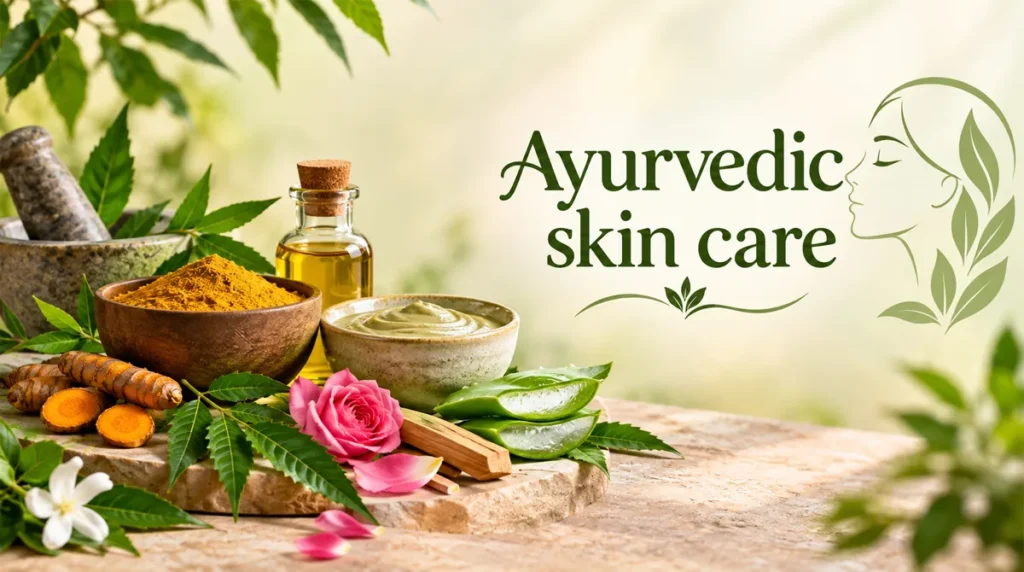
Ayurvedic skin care is rooted in India’s long standing tradition of using herbs, botanical ingredients, oils & mindful daily routines as part of personal care & wellness. Today interest in Ayurvedic skincare has expanded beyond India. People around world are exploring herbal skin care products & traditional approaches while also looking for clear ingredient information, simple routines & products suited to their individual needs.
But Ayurvedic skin care is not simply about replacing every modern skincare product with herbal alternative. A thoughtful routine starts with understanding your skin, choosing suitable products, reading ingredient information & using products according to manufacturer directions. In this Article we explain what Ayurvedic skin care means, how herbal ingredients are traditionally used, how to build simple Ayurvedic skin care routine & what to look for when buying herbal skincare products online & how Tanvi Herbals approaches Ayurvedic skin & personal care.
Ayurvedic skin care refers to skin & personal care practices inspired by traditional principles of Ayurveda. Ayurveda has long history in India & includes use of herbs, botanical ingredients, oils & traditional preparations as part of wellness practices.
An Ayurvedic skincare routine include products such as:
The exact ingredients & formulations differ from one product to another. For this reason it is important to evaluate Ayurvedic skin care product based on its actual formulation, ingredients, intended use & directions rather than assuming that every Ayurvedic product provides same benefits.
The biggest difference is not simply whether product contains herbs. Ayurvedic skin care is influenced by traditional wellness system that considers lifestyle, individual needs & the use of botanical ingredients. Modern skincare includes wide range of formulations developed around cosmetic science, dermatology & specific skincare functions.
The two approaches not necessarily have to be treated as opposites. A person use Ayurvedic herbal cleanser, for example while following modern skincare practices such as daily sun protection & gentle cleansing routine. The most useful approach is to understand what each product contains & how it fits into your routine.
Interest in Ayurvedic skincare has grown as consumers look for products with herbal & botanical ingredients & want to understand more traditional Indian beauty practices. Some common reasons people explore Ayurvedic skin care that includes:
Many Ayurvedic skincare products use herbs, oils & botanical extracts. Consumers who prefer plant focused personal care they find these ingredients interesting.
Ayurveda provides long standing tradition of herbal & personal care practices from India.
Many people prefer basic skincare routine rather than constantly adding multiple products.
Consumers increasingly want to know what they are applying to their skin & why particular ingredient is included in formulation.
Ayurvedic wellness often considers personal care as part of broader lifestyle that can include daily routines, nutrition, activity, rest & mindful habits.
Ayurvedic skincare is not one single type of product. Different products serve different roles in personal care routine.
Cleansing is one of the basic steps of skincare routine. A face wash is designed to remove accumulated dirt, excess oil, sweat & other surface impurities.
When selecting an Ayurvedic or herbal face wash then consider bellow points:
Avoid choosing cleanser simply because it contains the word herbal. The complete formulation matters.
Face packs are traditionally associated with Indian & Ayurvedic beauty routines. Depending on formulation of face pack contain herbal powders, clays, botanical extracts or other ingredients. Face packs should be used according to specific product instructions. If your skin is sensitive, introduce new product carefully & discontinue use if irritation occurs.
Creams and lotions are commonly used to moisturise & condition skin. Ayurvedic & herbal formulations that include plant oils, herbal extracts or other botanical ingredients. Tanvi Herbals has dedicated Creams & Lotions category, making it useful to connect this educational article directly with relevant product collection.
Some people prefer purchasing complementary products together rather than selecting individual products. A skincare kit can make it easier to follow routine when products designed to be used together. But it is still important to read the individual product information & understand how each product is used. Tanvi Herbals currently has dedicated Skin Kit & Skin + Hair Mix Kit within its Global product structure.
Ayurvedic personal care can also extend beyond facial skincare. Depending on product range, herbal personal care products get include preparations intended for areas such as lips & other parts of the body. Always follow the intended use information provided with the product.
One of the most interesting aspects of Ayurvedic skincare is its use of herbs & botanical ingredients. But an ingredient not evaluated simply because it is traditional or natural. Different herbs have different properties & final product depends on:
Therefore product containing an individual herb should not automatically be assumed to have same properties as another product containing same herb.
Depending on the formulation, traditional Indian & Ayurvedic skincare includes botanical ingredients such as:
Turmeric has long history of use in Indian traditional beauty practices. It is commonly associated with traditional face packs & personal care preparations.
Neem is another well known botanical associated with traditional Indian personal care. It is found in various herbal formulations, including preparations intended for skin & personal care.
Aloe vera is widely used in modern & traditional personal care products & it is commonly found in formulations designed around skin conditioning & hydration.
Rose water & rose derived ingredients have long history in Indian beauty routines & that are commonly used in cosmetic & personal care formulations.
Sandalwood has long association with traditional Indian beauty practices & it is used in various personal care preparations.
Plant derived oils are commonly incorporated into traditional personal care routines. The specific suitability of any ingredient depends on formulation & individual using product.
When buying Ayurvedic skin care products, the word natural or herbal is not your only deciding factor. A transparent product page should ideally provide information such as:
This helps customers to make informed decisions, especially when purchasing products online.
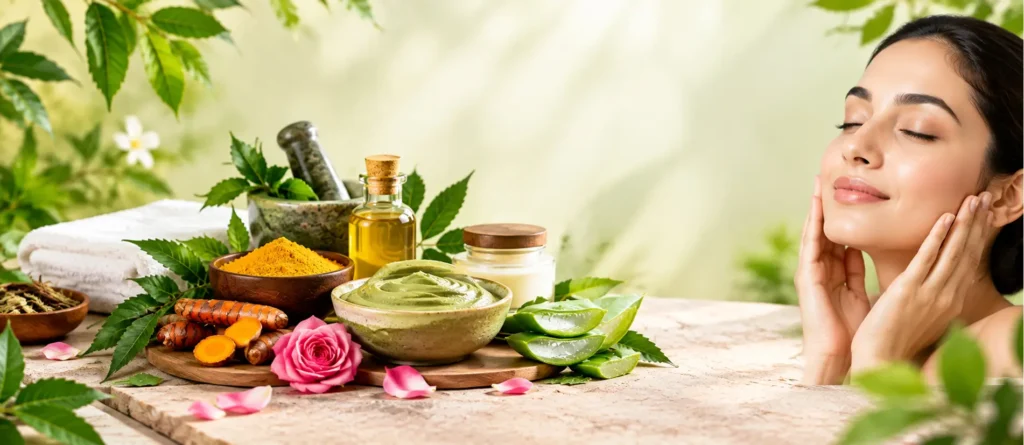
You do not need complicated 10 step routine to explore Ayurvedic skin care. A simple routine can begin with the basics.
Start with suitable gentle cleanser or face wash. Use product according to its directions & avoid excessive rubbing or scrubbing.
Choose suitable moisturiser, cream or lotion based on your skin’s needs & the product formulation.
If you are going outdoors then include appropriate sun protection in your routine. Ayurvedic skincare does not mean that modern sun protection practices get ignored.
Consistency is often more practical than constantly changing products. Use products according to their directions & give yourself enough time to understand whether routine suits you.
Your evening routine can also remain straightforward.
Remove accumulated dirt, sweat, sunscreen and makeup where applicable.
Depending on your routine this get include suitable cream, lotion, serum or other product.
Use suitable moisturising product if required.
Using too many products at a same time can make it difficult to identify which product suits you. Start simply & add products only when there is a genuine reason to do so.
Ayurvedic traditions often discuss individual differences in relation to concepts such as doshas. These concepts are an important part of traditional Ayurveda but consumers should careful about turning general Ayurvedic descriptions into fixed medical or dermatological diagnoses.
For everyday skincare, practical factors such as following factors are important:
Your skin can change over time. A product that worked well during one season that not feel same during another. This is why skincare should reviewed according to your current needs.
Dry skin benefit from routine focused on gentle cleansing & appropriate moisturisation. Avoid excessive cleansing or aggressive exfoliation if it leaves skin feeling tight or uncomfortable. Look for products formulated for moisturising & conditioning according to your individual needs.
Oily skin can benefit from balanced cleansing routine without excessive scrubbing. Using overly harsh products make skin feel uncomfortable & that is not suitable for everyone. Choose products based on their formulation rather than simply selecting the strongest cleanser available.
Combination skin can have different characteristics across different areas of the face. A simple routine can help you to understand how your skin responds before introducing additional products.
If your skin is sensitive then pay particular attention to ingredient list. Introduce new products carefully & consider patch testing where appropriate. Stop using product if it causes significant irritation & seek professional advice when necessary.
Ayurvedic wellness is broader than skincare products alone. Traditional wellness practices often consider everyday habits alongside personal care. A sensible skincare routine can be supported by:
A skincare product is not viewed as replacement for healthy lifestyle habits or professional medical care.
One of the most important things to understand about Ayurvedic & herbal skincare is that natural does not mean risk free. Plant derived ingredients can still cause irritation or allergic reactions in some individuals.
Before using a new product consider following points:
If you have an ongoing skin condition then do not rely on cosmetic or herbal product as substitute for appropriate medical diagnosis or treatment.
Buying herbal skincare online is convenient but it requires careful product evaluation.
Read the full ingredient information available on product page then do not select product only because its headline says herbal or Ayurvedic.
Every skincare product has specific intended purpose. Before purchasing a product read the description and directions carefully.
Think about whether your skin is dry, oily, combination or sensitive. This can help to narrow down suitable product options.
Look for information about company, its background and its approach to product formulation. Tanvi Herbals describes itself as an Ayurvedic wellness brand established in 1992 & states that it combines selected herbal ingredients with its Ayurvedic Satva concept.
Customer reviews can help you to understand people’s experiences but individual results are not guaranteed. A review is not be treated as clinical evidence that product will produce the same result for everyone.
If you are purchasing from outside India then check bellow factors:
Regulations for cosmetics, supplements & herbal products that can vary between countries.
Tanvi Herbals has been associated with Ayurvedic wellness since 1992. The Global website currently includes dedicated skin care sections for Face Wash & Serum, Face Packs, Creams & Lotions & Burns, Cuts & Lip Care alongside dedicated skin and Skin + Hair combination kits. The brand describes its approach around selected herbal ingredients & the Ayurvedic Satva concept. This gives customers the opportunity to explore different types of herbal personal care products rather than relying on single skincare format.
If you are looking for herbal skincare products then explore the relevant Tanvi Herbals skin care collection to compare available products & review their individual ingredient & usage information.
The terms Ayurvedic and Plant based are related but not identical. Ayurvedic skin care refers to skincare inspired by the traditional principles & practices of Ayurveda. Plant based skin care generally describes products that use ingredients derived from plants.
A product plant based without being Ayurvedic. Similarly an Ayurvedic formulation that contain plant derived ingredients but should evaluated according to its specific formulation & traditional context. This distinction is useful when shopping online because marketing terminology can vary between brands.
Natural skincare is another broad term used across beauty industry. The term can refer to products marketed around naturally derived ingredients but its exact meaning differ between brands & markets. For this reason consumers should look at actual formulation rather than relying solely on labels such as:
Ingredient transparency is more useful than marketing label by itself.
More products do not necessarily create better skincare routine. Start with basic products & introduce additional products carefully.
Constantly changing your routine makes it difficult to understand which products suit your skin.
A natural ingredient can still cause irritation or sensitivity.
Ayurvedic skincare should not considered replacement for sensible sun protection practices.
Skin care is generally routine rather than one time solution. Avoid products making unrealistic promises of instant or guaranteed results.
Your skin & circumstances differ from someone else’s. Use other people’s routines as general information rather than personalised prescription.
Ayurvedic skin care is a approach to personal care inspired by traditional Ayurvedic principles & use of herbs, botanical ingredients, oils & traditional preparations.
Not necessarily. Skin & ingredient sensitivities vary between individuals. Choose products according to their formulation & your personal needs.
Traditional Ayurvedic & Indian beauty practices include ingredients such as turmeric, neem, aloe vera, rose, sandalwood & various herbal oils. The ingredients used depend on individual formulation.
Some Ayurvedic skincare products are designed for regular use, while others have specific directions. Always follow the instructions provided with the individual product or consult with professional doctors before use .
No. The terms overlap but they have different meanings. Ayurvedic skin care is associated with Ayurveda while natural skin care is broader term relating to naturally derived ingredients.
Product suitability depends on formulation & individual. Natural or herbal ingredients can still cause irritation or allergic reactions. Review ingredient list & seek professional advice when necessary.
Some people combine Ayurvedic & modern skincare products. But introducing multiple new products at once can make it difficult to identify irritation or sensitivity. Keep your routine simple & introduce products thoughtfully.
Check the ingredient list, intended use, directions, product quantity, brand information, customer reviews and relevant warnings. Also consider whether the product is appropriate for your skin type.
Cosmetic and wellness articles should not make unsupported disease treatment claims. If you have persistent or diagnosed skin condition then consult an appropriately qualified healthcare professional.
You can explore the Tanvi Herbals Global skin care collection online & review individual product information before purchasing.
Ayurvedic skin care brings together traditional Indian herbal knowledge, botanical ingredients & everyday personal care practices. A good Ayurvedic skincare routine does not need to be complicated. Start with the basics, understand your skin, choose products carefully & pay attention to the ingredients & directions.
Whether you are exploring herbal face washes, face packs, creams, lotions or skin care kits, focus on the actual formulation rather than relying only on words such as natural or herbal. For international customers exploring Ayurvedic & herbal personal care, Tanvi Herbals offers range of skin care products within its wider Ayurvedic wellness collection, backed by brand history dating to 1992.
Disclaimer: This article is provided for general educational purposes & does not constitute medical advice, diagnosis or treatment. Individual responses to skincare products can vary. If you have persistent skin concern, allergy, diagnosed skin condition, or are unsure about using particular ingredient consult qualified healthcare professional or dermatologist.